
.png?width=1289&height=1254&name=The%20Complete%20Guide%20to%20Artifical%20Intelligence2%20(1).png "The Complete Guide to Artifical Intelligence2 (1)")
What AI means for the hotel industry
While artificial intelligence clearly has a role in computing, it can be tricky to pinpoint the exact role AI should play in a hospitality environment.
First, we need to understand how AI can genuinely support hotels, moving beyond buzzwords and flashy marketing. AI obviously offers diverse benefits, but does this mean your hotel needs every new AI tool? Should hoteliers adopt AI simply to appear innovative?
In an episode of GuestRevu’s podcast, Back of House Banter, José Soares, Director of IT at The Capital Hotels, emphasised that hoteliers must identify specific operational challenges or use cases before introducing any AI solution. By focusing on areas that deliver tangible benefits, hoteliers can maximise ROI and avoid costly mistakes.
He points out that: "... a lot of people don't actually know, particularly in the hospitality space, what it is that they want to do. They just know that AI is this cool word at the moment, and I've got to have it in my strategy.”
Most industry experts agree that a prime application of AI in hospitality is automating repetitive tasks, thereby freeing up staff to deliver more meaningful, personal guest interactions. Louise Hibbert, Director of IT at SHR, emphasises:
"I think the use of AI, particularly in this day and age, is essential because I think it can automate a lot of mundane tasks. It can also help surface data and insights that actually otherwise would perhaps be more of a manual task. So I think what it does is it frees up hoteliers, particularly those in more operational roles, to support and help their teams and their guests more readily.”
While using AI to streamline operations is widely supported, judicious application is essential. Operational efficiency is essential, but it must never come at the expense of true hospitality.
Podcast panellists Amy Branford, Senior Guest Intelligence and Growth Specialist at GuestRevu, and Louise Hibbert stressed that AI should be viewed as a tool to enhance human capabilities rather than replace team members.
As Paul Griffiths, Head of Growth at GuestRevu, well said at the Next Wave Hospitality event in London:
The question hoteliers should be asking themselves is not, 'Can this be automated?’ Instead, hoteliers should be asking, ‘Will this make the experience better for the guest, easier for the team, or more useful for the business?’

Paul Griffiths,Head of Growth,GuestRevu
Another great benefit is how AI-powered tools can (and should) also be used to personalise hotel services, such as curating tailored offerings from room recommendations to dining suggestions. Instead of offering a generic upgrade or sending a cold email, AI makes it that much easier to adjust your sales and marketing to your target guest.
AI elevates existing customer service experiences, but its capabilities extend far beyond guest relations. It also helps hospitality leaders identify broader market trends and make data-driven operational decisions based on AI-generated recommendations.
Whether you’re looking to AI to provide a more human touch where it counts, want to identify areas for improvement, or are simply trying to pinpoint the best place to start, knowing what is possible with AI and seeing it in action are two entirely separate scenarios
How AI is changing hotel discovery
Even if a hotel chooses not to integrate AI into its operations, its strategy and overall workflow will still be affected. This is because AI is already making a major impact on how guests discover hotels. In fact, 40% of travellers already use AI tools to plan their trips.
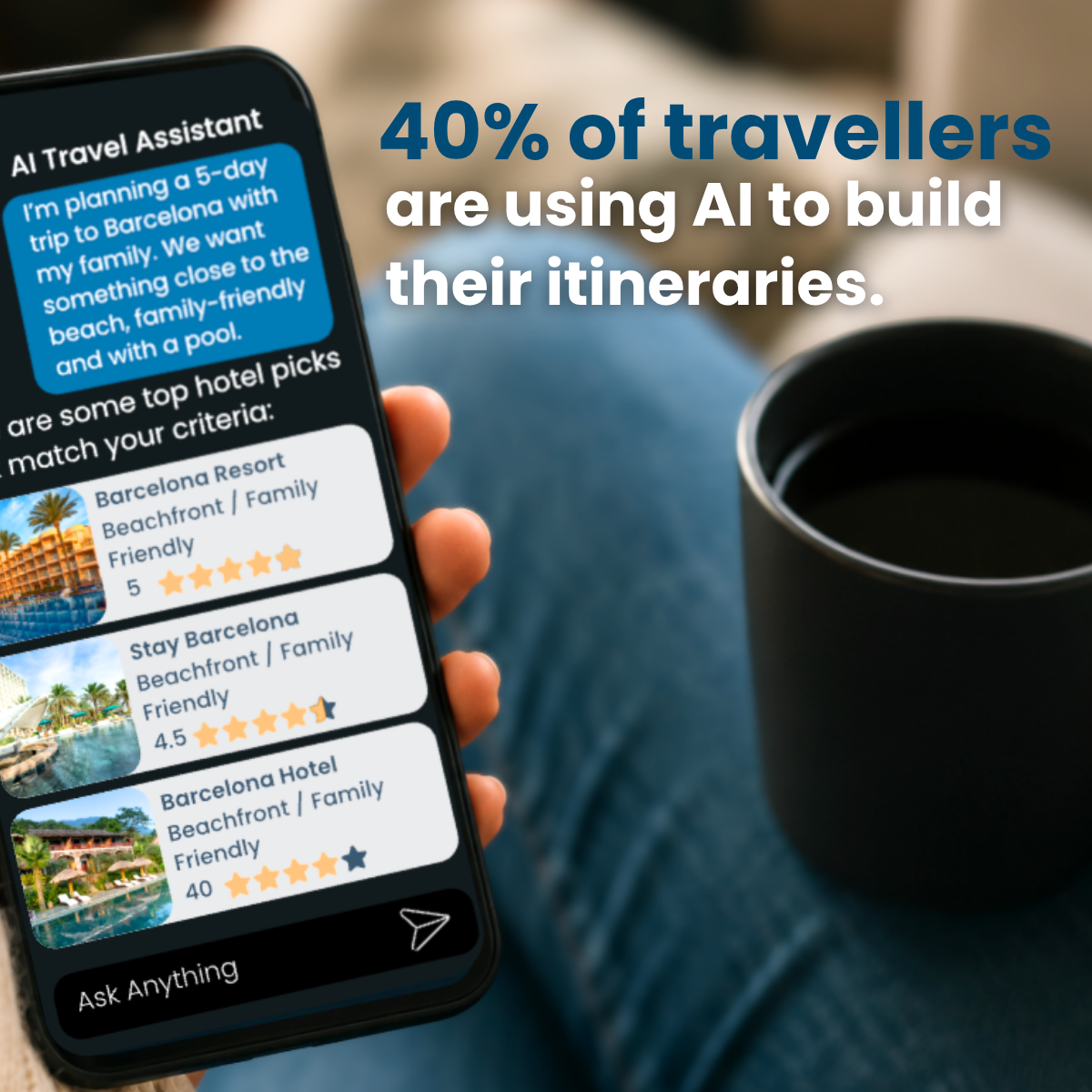
While traditional search rankings still matter, AI-powered answer engines and generative platforms are transforming online visibility. Instead of wading through a long list of blue links, travellers asking for hotel recommendations now receive a curated shortlist tailored precisely to their needs and preferences.
This means that it is crucial that your hotel gets on the list. Even though things are still evolving, covering the fundamentals will help ensure your hotel is front and centre when your target guests make their selection.
To make recommendations, AI tools collect data from various sources, including your website, online listings, review sites, social media, and industry publications. AI systems must be able to understand your hotel and its online presence. If a hotel's digital footprint is generic or fragmented, AI models will default to better-documented competitors and OTAs.
Consequently, maintaining accurate, consistent property information across every channel is critical. Adam Hamadache, CEO of Formula, explains in an episode of the Back of House Banter podcast:
"Clarity of your business is essential to being recommended by AI. As soon as you become unclear or inconsistent, that inhibits the ability to get recommended because it sees that as a bit of a weakness and therefore it becomes less likely to suggest you as whatever the prompt is.”
Because AI search engines tend to cite third-party sources over brand-produced content, monitoring your online reputation and investing in targeted PR can significantly boost visibility and increase your chances of being recommended.
.svg)
Having a guest review strategy is also key in the battle for AI visibility. Guest reviews provide the essential 'human proof' and legitimacy that AI tools demand. Adam Hamadache highlights how online reviews reveal the real guest experience and directly influence which hotels get recommended:
He adds: “The way the LLMs will be able to find this information, most notably, will be within the reviews. [...] The omnipotence of these LLMs: they can see everything that's ever been said and the recency of when it's been said. And then be able to determine: "Actually, don't stay at this hotel because a lot of guests say it's quite noisy, but at this hotel a lot of guests are saying it's really quite.""I think it's the things that you never think to talk about on your website that are perhaps really important to your customers. And this is where online reviews come into play. [...] They (customers) will be sharing with the AI what is important to them.”

Adam Hamadache,CEO,Formula
Digital marketing expert explains the new rules of visibility in AI-powered search [podcast]
More than that, even though you cannot control what guests say about your property, managing and responding to reviews allows you to regain narrative control over the experience your hotel offers. Therefore, every guest review should be treated as an important brand signal.
The AI impact on pre-stay and in-stay
The reality of today’s AI is often less about robotics and more about analysis. Information and communication technology has evolved to the point where we now have a massive amount of hotel data that we can collect and learn about guest profiles, behaviour, and preferences.
To deliver real value, AI must be powered by your hotel’s proprietary operational data rather than generic industry benchmarks.
When effectively managed, this data provides the foundation for refining marketing campaigns, optimising inventory, adjusting pricing strategies to real-time demand, streamlining operations, and—crucially—delivering personalised guest experiences.
But harnessing this data comes with a caveat: AI is only as good as the information feeding it. Speaking at the Next Wave Hospitality event in London in May 2026, Arik Fletcher, fractional CTO at Focus Group, issued an important warning to hoteliers regarding the indiscriminate use of AI:
“I think the thing to remember with AI is it’s a force amplifier. Bad data, bad systems, bad processes, bad practices- they'll get worse with AI. Good practices, good systems will get better with AI. It's not going to solve a problem that you can't solve yourself; it just does things faster.”
Forward-thinking hotels are already leveraging AI to automate check-ins, hyper-personalise stays, and resolve maintenance issues before guests notice them. AI also empowers you to, for example, deliver the right upsell at the exact moment of need and alert staff to VIP arrivals.
AI makes personalisation a part of every guest's stay by analysing behavioural signals to suggest ‘next best actions,’ ensuring that your communication feels relevant, immediate, and genuinely helpful. With the right information and AI analysis, hoteliers can offer guests tailored recommendations that feel helpful rather than pushy, boosting revenue and reinforcing the guest’s sense of being understood.

The AI-review feedback loop
Surveys are only sent after the stay, right? Not anymore. Short in-stay surveys shared with guests through QR codes or integrations with existing guest messaging tools can help hotels pick up on small issues before they become bigger problems.
These quick touchpoints allow on-property teams to resolve concerns in real time rather than waiting until check-out, protecting the guest experience while it unfolds and preventing negative online reviews down the line.
Post-checkout surveys remain equally important, offering a valuable opportunity to hear directly from guests and gather insights that might otherwise go unnoticed.
John Rogers, General Manager at LUX South Ari Atoll, highlights how guest feedback is vital for operational improvements: "Guest feedback is the cornerstone of our continuous improvement process. We analyse all feedback channels, including surveys, reviews, and direct interactions with team members. This allows us to identify trends, understand guest expectations, and implement changes to refine our service standards."
Analysis of 1500+ hotels’ surveys reveals the secret to better response rates
But collecting and analysing guest feedback is not the end of the journey. Especially when we think about online reviews. TripAdvisor, Booking.com, and Google are among the most popular review platforms (and often the most daunting for hoteliers).
As mentioned earlier in this article, online reviews are not just rates and comments after check-out. They now play a very relevant part at the beginning of the journey: hotel discovery.
Today, guest reviews are also a critical source of data for AI answer engines and LLMs, directly influencing whether your property is featured during the discovery phase of the traveller journey. AI tools rely on fresh, detailed reviews to understand the true guest experience and match recommendations to specific traveller preferences. More than just simply targeting the right keywords, maintaining an active stream of online reviews is essential for securing a spot on AI-generated shortlists.
Check out how you can apply guest intelligence throughout the guest journey
Beyond collecting a large volume of reviews, hoteliers must actively manage and respond to them. Replying to online feedback allows you to regain control of the guest narrative, address specific experiences, and provide search engines and AI models with additional context to power future recommendations. Importantly, it also reassures and influences prospective guests who read these responses while deciding whether to book your property.
However, managing and responding to all surveys and reviews from all sources can be challenging. Hotel technology, like GuestRevu, gathers all your hotel’s feedback into one central platform, making it easier to respond to reviews, manage guest sentiment and stay on top of feedback without switching between different channels.
.png?width=1000&height=677&name=Great%20location%20and%20excellent%20service.%20The%20breakfast%20was%20a%20highlight!%20(18).png)
GuestRevu’s AI analytics tools handle the heavy lifting by identifying key themes and sentiment trends in just a few clicks. These actionable insights empower hotel teams to direct time and budget toward high-impact operational improvements.
Chris Alexandre, Founder and CEO of GuestRevu, explains: “Guest feedback holds the answers to better experiences, smarter investments, and stronger reputations, but finding those answers can be time-consuming.” He adds:
“AI Analytics does the heavy lifting by distilling thousands of comments into clear, actionable insights, helping teams spot problems before they escalate and celebrate the things they’re getting right.”
Better experiences lead to stronger reviews and a more positive online reputation over time, which leads to more AI visibility and more bookings. And so, the end becomes the beginning of a whole new journey.